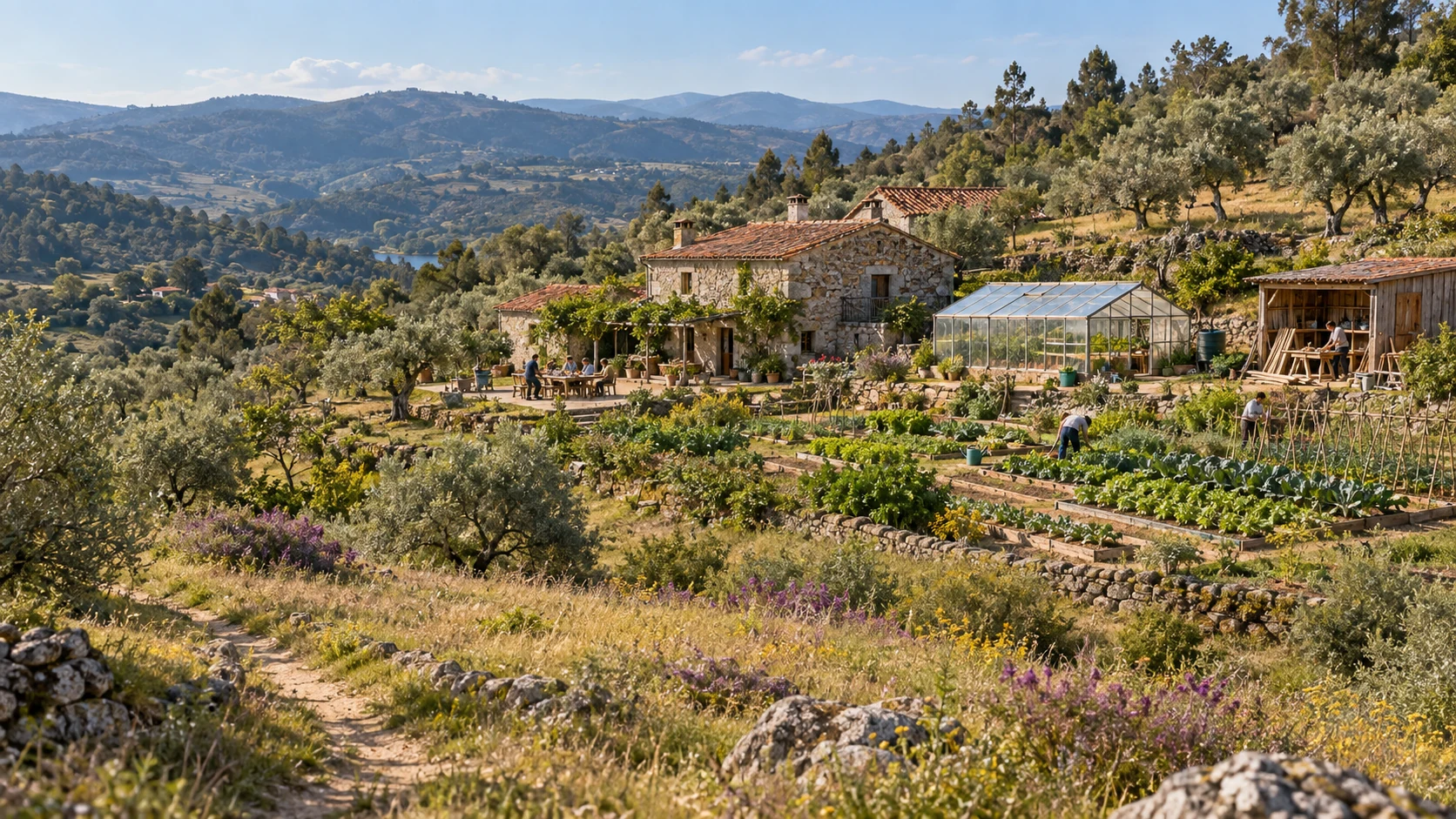
An illustrative wide view of a productive Portuguese landscape and working House
Illustrative vision · AI-generated

Our Activities · The House Cooperatives

A broad ambition.
A focused place to start.

We intend to build a Cooperativa Multissetorial—a multisector cooperative—with activities that can sustain the House, offer useful work and become a setting for practical learning.

Four proposed kickstart programmes. Likely first branches: Agriculture, Services and Worker Production. The land, capable people and actual demand will shape what starts first.

The first programmes we envision

Agriculture

Microgreens Program

Grow fresh microgreens for restaurants, shops and local customers.

Why start here
Short growing cycles allow small trials and frequent feedback on quality, demand and production costs.
What it needs
A suitable growing space, water, reliable cultivation skills and a workable route to customers.
What we would test

Product quality, food-safety requirements, repeat demand, delivery rhythm and whether the price covers labour, inputs and the activity’s contribution to shared costs.

Services

Non-Formal Education Programmes

Run practical workshops, facilitated learning and training with experienced practitioners.

Why start here
Teaching turns existing expertise and useful work into a service while helping people develop skills together.
What it needs
Capable trainers, a clear learning offer, suitable facilities and enough paying participants or programme partners.
How the scope is defined

These are proposed non-formal education services, rather than an assumption that the House begins as a formal teaching institution. Content, staffing and programme conditions follow the actual learning offer.

Worker Production / Services

Tiny House Program

Develop practical construction skills through small structures, workshops and assisted self-build formats.

Why start here
A tangible product connects making, technical learning and useful facilities, with formats that can be tested separately.
What it needs
Technical leads, tools, safe workspace, suitable designs and clarity about who owns the finished structure.
Three possible formats
  • Worker production: a member-led team makes structures.
  • Services: participants pay for practical training.
  • Commercialisation: a kit or finished structure is supplied with assisted self-build support.

The activity and ownership arrangements determine the appropriate classification and requirements. This is not being presented as a Housing and Construction programme.

Worker Production

Plant-Based Food Program

Develop and produce plant-based foods for local customers and distribution partners.

Why start here
Repeatable products can support regular demand and become a practical blueprint that other cooperative teams can adopt.
What it needs
A suitable kitchen, tested recipes, food-safety procedures, capable producers and real demand.
What we would test

Product appeal, consistent quality, production and packaging costs, useful sales channels and the ability to support the people doing the work.

One way to multiply livelihoods

You do not need to invent a new idea.

A proven plant-based food programme could become a blueprint for new regional cooperatives: shared recipes, methods, quality standards and mentoring, with local teams running their own work.

  1. Proven House programme
  2. Blueprint + practical mentoring
  3. Autonomous regional cooperatives
  4. Shared standards + network innovation
How a cooperative network could work

The originating cooperative shares recipes, operating procedures, quality control and practical mentoring. New teams test delivery locally and develop autonomous worker cooperatives.

Shared brand stewardship, purchasing, marketing and agreed standards can support the network while regional cooperatives retain their own operations and democratic governance. Innovations developed locally can be tested and shared across the network.

A later union of cooperatives is one possible structure for shared functions. It would not automatically merge the regional enterprises. Membership, brand use, quality requirements and decision-making would need clear agreements.

Ten branches in the longer-term vision

Portugal’s Cooperative Code recognises twelve branches. Our intended scope spans ten, developed in stages rather than launched together:

  • Agrícola Agriculture
  • Artesanato Crafts
  • Comercialização Commercialisation
  • Consumidores Consumers
  • Cultura Culture
  • Ensino Teaching
  • Habitação e Construção Housing and Construction
  • Produção Operária Worker Production
  • Serviços Services
  • Solidariedade Social Social Solidarity

The first programmes are expected to centre on Agriculture, Services and Worker Production. Commercialisation may be relevant to particular tiny-house formats. Registration and programme classifications will follow the actual activities and applicable requirements.

Portuguese Cooperative Code · Article 4

How the activities can reinforce one another

Stay, learn and experience the region

Agriculture, Services and Culture could later combine in short stay-and-learn weekends: growing, food, local crafts and encounters with Sustainable Development Goals topics. Such offers depend on the property, facilities and operating requirements.

Turn useful work into teaching

Growing, producing and building can become courses, internships and learning programmes. Formal Teaching activities may develop later where appropriate; practical learning can begin within the initial Services offer.

Build before incubating

The Incubation Program belongs within Services, alongside research and development. It is not a separate entity and is not the first programme to launch. It follows the establishment of a working House and the resources to support teams.

Explore the later Incubation Program